
Brazil Bans Crypto in Cross-Border Payments


Central Bank of Brazil Issues Ban on Crypto Utilization As Part of Regulated Cross-Border Settlement System
Key Takeaways:
- On April 30, the Central Bank of Brazil issued Resolution 561, banning crypto in cross-border payments.
- Analyst Victor Alfa notes this 2025-reviewed ban forces firms to abandon on-chain efficiency for fiat.
- Taking effect on October 1, the Central Bank will exclusively require fiat usage for foreign exchange flows.
The Central Bank of Brazil is moving to curb the institutional adoption of cryptocurrency assets, including bitcoin and stablecoins, within its regulated cross-border payment system.
Resolution No. 561, published on April 30, amends earlier resolutions to improve the provisions of international payments of transfer services, banning cryptocurrency as an option that institutions providing these cross-border payment and exchange services can tap.
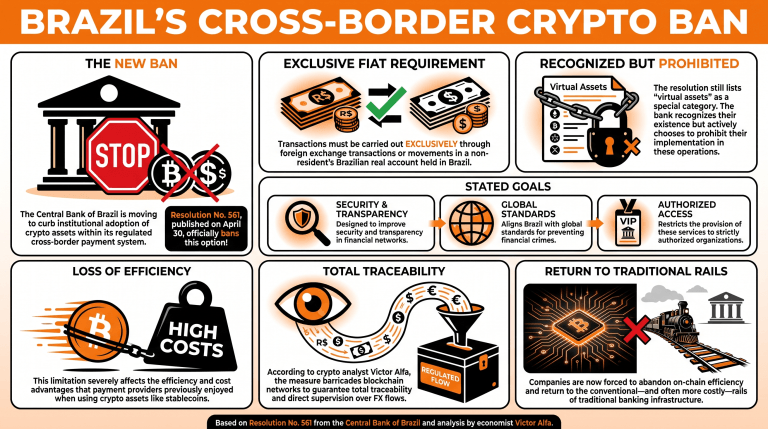
The document stresses that these transactions must be carried out “exclusively: I – through a foreign exchange transaction or movement in a non-resident’s Brazilian real account held in Brazil, with the use of virtual assets being prohibited.”
Nonetheless, the resolution, which comes into effect on October 1, lists “virtual assets” as a special category identifying transactions, meaning the bank recognizes their existence but chooses not to allow their implementation in cross-border operations.
The bank clarified that these regulations had been approved to “improve security, transparency, and greater alignment of Brazil with global standards for preventing financial crimes,” and followed a public consultation held in 2025, restricting the provision of these services to organizations authorized by the institution.
Even so, this has been taken as a limitation that could affect the efficiency and cost advantages these providers enjoy when using crypto assets, especially stablecoins, to execute these operations.
Victor Alfa, economist and crypto analyst, stressed that while this measure did not bring the regulated system down, it barricaded blockchain networks from becoming parallel transfer value channels as it seeks to guarantee total traceability and direct supervision over FX flows in Brazil.
“Innovation in the settlement layer suffers a severe blow. Companies in the sector will be forced to abandon on-chain efficiency and return to the conventional—and often more costly—rails of traditional banking infrastructure,” he assessed.



